
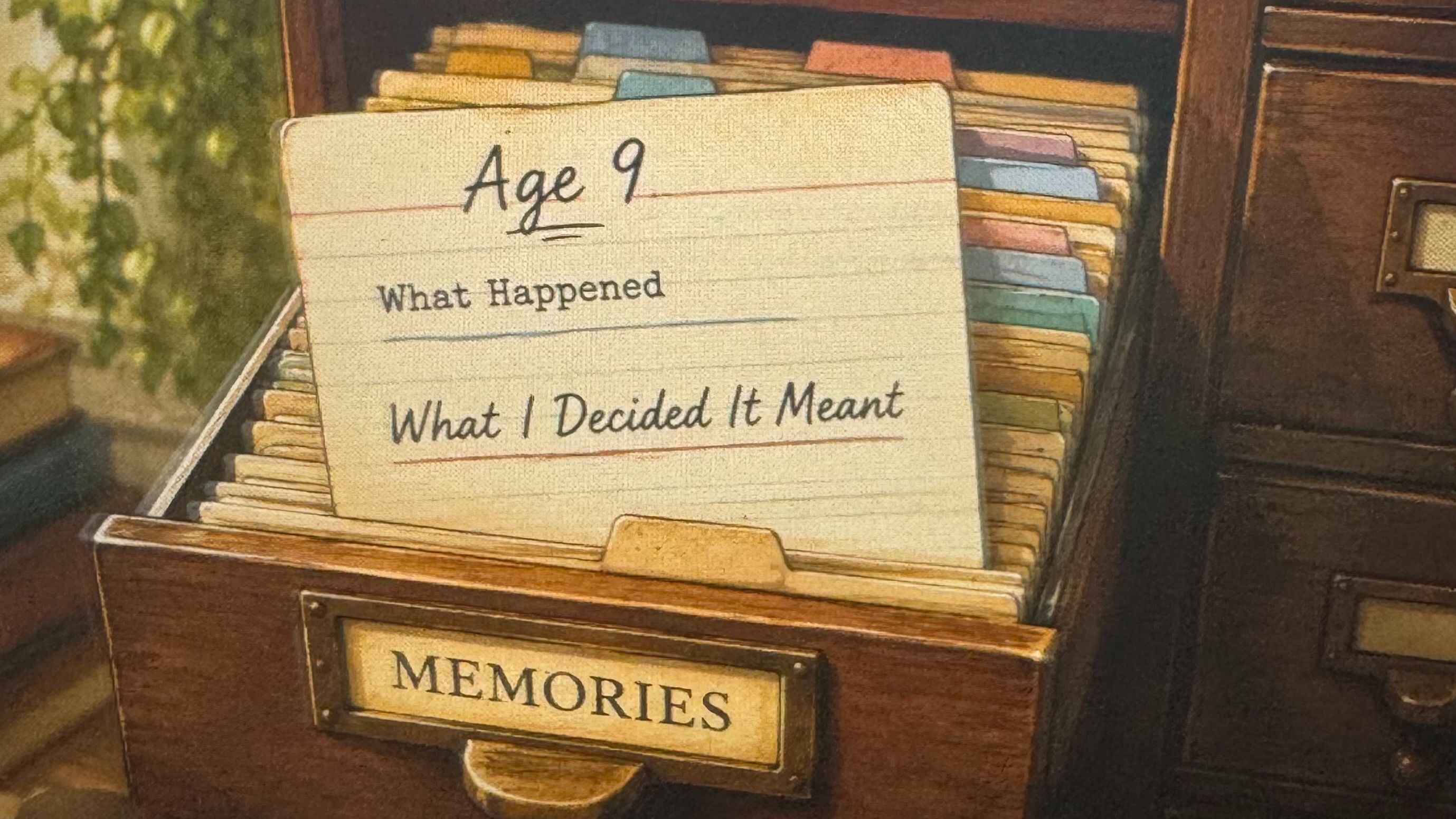
"It's not what happens to us that causes us to suffer; it's what we believe about it."
Byron Katie
In “The Book of Alchemy”, Suleika Jaouad writes of a story told by Oliver Sacks in his memoir; a memory he had of a bombing behind his home during WWII. He describes being there in vivid detail. So vivid and so real that he was shocked when his brother Michael told Oliver that he was not, in fact, there. He had been sent to Braefield, a boarding school in the country, at the beginning of the war. Oliver’s memory came from a very detailed letter that his older brother had written. He had adopted his brothers experience as his own, retelling the story as his until he was corrected.
Many years after my mother’s death in 1996, I was sitting with my sister-in-law discussing the Saturday night before Mom died. My sister-in-law shared her memories and experience with me, but as she was telling it, I was convinced that we could not have possibly been in the same room. Her memory of what happened, what was said or not said, every bit of it was not at all what I remembered. That conversation stuck with me and started my quest into memory. What is it really? And is it real?
A major review in Psychological Bulletin explains that false memories can occur for both spontaneously remembered information and for memories influenced by suggestion. Even, and maybe most especially, emotionally intense events are not immune to distortion. In other words, research suggests that memory can be highly malleable. People may fill in missing details to make events feel coherent. Emotion can shape what is remembered. And repeated retelling can gradually change the story.
Most of us trust our memories. Not because we've fact-checked them, but because we've carried them for so long that they feel like facts. We tell ourselves stories about our lives. The day we were rejected, the day we failed, the day we overcame, day we moved on. The time someone let us down or the conversation that confirmed our belief that we were not good enough. Our memories help explain why we became who we are.
Over time, these stories become part of our identity. We stop remembering the event and start remembering the meaning. Not the truth of what happened, but how it made us feel. The problem is that memory is not a recording. It is a reconstruction.
Every time we revisit a memory, we don't pull a perfectly preserved file from storage. We rebuild it. We fill in gaps. We emphasize certain details and forget others. We view the event through the lens of who we are today. The story changes even when we don't realize it. And yet many of us build entire lives around conclusions drawn from memories we have never questioned.
We remember a teacher criticizing us, feeling left out, someone choosing someone else, being embarrassed. Those memories may be accurate. But the meaning we attached to them is often where the real impact occurred. Somewhere along the way, we added a sentence. We incorporated our feelings and the memory they created became part of our identity.
The memory was expanded to include false beliefs. I’m not smart enough, I don’t belong, I am not lovable, I always disappoint people. The events happen in a moment. The story lasts for decades.
What if the most important question isn't whether the memory is true? What if the more important question is whether the interpretation is true?
Think about a memory that has shaped your life. Maybe it is something painful. Maybe it is something you have repeated so many times you no longer question it. Have you ever stopped to ask yourself… What did I decide this meant about me? For me?
Most of us have never separated the event from the conclusion. A failed relationship becomes evidence that we're difficult to love. A career setback becomes evidence that we're not capable. A childhood experience becomes evidence that we don't matter.
But events and interpretations are not the same thing.
Two people can experience the exact same event and walk away with completely different stories. One sees rejection and decides they are unworthy. Another sees rejection and decides they simply weren't a fit. One sees hardship and concludes life is unfair. Another sees hardship and concludes they are resilient. The facts may be identical. The meaning is not.
This isn't about pretending painful things didn't happen. It isn't about rewriting history or forcing positivity onto experiences that hurt.
It is about becoming curious.
What else could be true? What if that teacher's criticism had more to do with their stress than your ability? What if that breakup wasn't proof of your inadequacy but evidence of incompatibility? What if the thing you thought broke you was the thing that taught you to survive?
The older I get, the more I believe that healing often begins when we stop asking, "What happened to me?" and start asking, "What story did I create because of what happened to me?"
While we cannot change the past, we can examine the meaning we've been carrying from it. And sometimes the meaning has become heavier than the event itself. Perhaps the goal isn't to remember differently. Perhaps the goal is to understand differently.
To look at the same memory with wiser eyes. To see the younger version of ourselves with more compassion. To recognize that the story we created may have helped us survive at the time but may no longer serve the person we are becoming.
Our memories help shape our identity. But they do not have to imprison it. The most powerful memories are not always the ones we revisit. They are the ones we finally re-examine. And sometimes the moment that changes your future is not discovering a new memory. It's discovering a new meaning.
Here is a question to consider, “What memory from your life still influences your choices today and is the meaning you have attached to it still holding you hostage?”
Much love,
Lisa
If you enjoyed this blog and believe someone else might enjoy it as well, please feel free to forward. If this was forwarded to you and you would like to hear more, please sign up below to receive future emails.
Lisa Hamil is a founding member and host for The SOS Collective, an online international women’s recovery and support group. However, this blog and any classes or coaching offered by Lisa Hamil LLC are separate from and not affiliated in any way with The SOS Collective.
Stay connected with news and updates!
Join our mailing list to receive the latest news and updates from our team.
Don't worry, your information will not be shared.
We hate SPAM. We will never sell your information, for any reason.
