
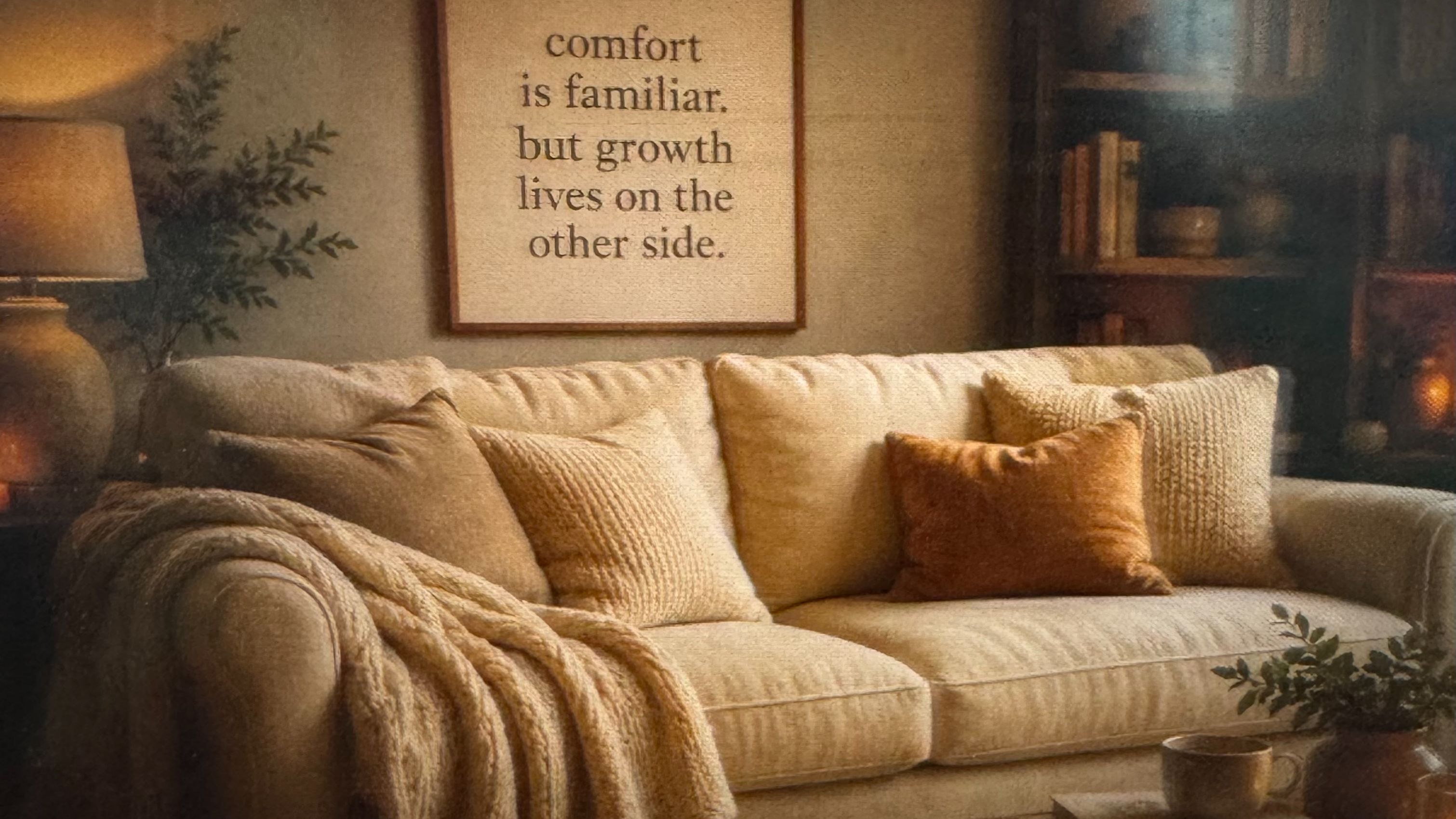
“Your nervous system will always choose a familiar hell over an unfamiliar heaven.”
Kathy Overman
What if the exhaustion you feel is not a physical tired? Not worn out because you have been doing too much. But, instead, you are exhausted because you've been spending enormous amounts of energy protecting a life you have outgrown?
Most of us assume change is what drains us. New habits, routines, decisions, opportunities. New identities. Of course that is all exhausting. But what if staying the same is just as expensive? What if the real question isn’t, "Do I have the energy to change?" But "Where is my energy going?"
We expend mental energy every day. Perhaps it is time to question if we are using it to simply maintain the familiar or to participate in becoming someone new. Change is hard. Exhausting even. When we consciously spend our energy on changing, we expect to feel tired. But what is the energetic cost of staying the same? The cost of our participation in “comfortable”?
We assume we only have two choices. Stay where we are. The easier choice. The comfortable choice. Or change. Change is challenging. It often feels exhausting before we even start. While these seem like the only two logical choices, perhaps the real question should be, which form of exhaustion are you willing to choose? Because both require energy. Both can be exhausting.
We often compare the effort required to change with our version of staying the same. As if staying the same costs nothing. However, change is inevitable. So instead, we need to consider how best to move forward. Focused on what we already know. Or on becoming someone that feels more authentic. What surprises me most is that becoming more authentic doesn't necessarily require more energy than staying the same. It simply asks us to spend that energy differently.
Staying the same costs attention, decision-making, shame, self-negotiation, fear. It costs carrying around in our head thoughts of an un-lived life. The one we dream about, think incessantly about, but do not move toward. The cost of dreaming is largely invisible because it happens in our mind. No one else can see these thoughts so we believe they are not taking up “real” energy. They are just our dreams, right?
Your brain is metabolically expensive. Although it makes up only about 2% of your body weight, it uses roughly 20% of your body’s energy. Most of that energy goes toward prediction, attention and maintaining EXISTING patterns.
Changing those patterns is expensive because several systems are working simultaneously. The prefrontal cortex must stay engaged, making deliberate choices instead of allowing habits to run automatically. Habit circuits in the basal ganglia are resisting the interruption of well-established routines. The anterior cingulate cortex detects conflict every time your new intention disagrees with your old habit. The amygdala often interprets uncertainty as potential danger, even when the change is objectively good.
All of that requires glucose, oxygen, attention, and mental effort. So yes... change makes us feel tired. Not because you are weak. Because your brain is doing something it rarely has to do. Rewrite prediction. Expect uncertainty.
But here is the twist? The brain is working just as hard when we are AVOIDING change. The best example I have is when I continued drinking even though I knew I needed to stop. I invested many hours every day, not in dreaming about a life without alcohol, but on wishing I didn’t need to change.
I never spent a large part of my day drinking, maybe 1-2 hours. But I spent about 12 hours a day thinking about it. Should I? Shouldn’t I? Maybe just one. Which liquor store did I go to most recently? I’ll stop on Monday. What will people think? Or say? I will only drink on the weekends. Will anyone notice anyway? I deserve it. I can’t. Tomorrow will be different. My “thing” was alcohol. But any “thing” you promise yourself you will not do again tomorrow is your way of numbing. Of living in comfortable. Avoiding what you feel you want most. And all that internal negotiation takes a lot of energy.
That loop is incredibly expensive. Psychologists call this cognitive load. I call it rumination. And rumination is even more exhausting than thinking about the dreams I may never achieve. It is exponentially more damaging to my soul. No matter how you want to move forward in your life, you will spend WAY more time thinking about what it would take to change than taking action.
The opposite of change isn’t rest. It’s maintenance. Maintaining a life that no longer fits…takes work. Maintaining an identity that you have outgrown…is work. Maintaining habits you secretly want to leave behind…also work. Maintaining a story that no longer feels true…is exhausting.
Our brains love certainty more than they love happiness. People stay in jobs they hate, relationships they have outgrown or habits they know are hurting them. Predictability requires less brain power than uncertainty. The familiar is metabolically cheaper, but the energetic cost is FAR greater. A daily hit to our soul when the brain is saying, “Let’s stay here” but the heart is whispering, “I can’t stay here anymore.” That tension, that loss of self, is exhausting.
We describe our attachment to the way things are as “easier”, but attachment isn’t passive. It’s active. It requires participation. We spend enormous amounts of time and ENERGY trying to maintain the status quo rather than examine and move toward what life is here to offer us. Staying stuck takes a LOT of effort.
Change begins with noticing. Where is your energy already going? Not where you wish it was going, where is it really going? How many hours do you spend worrying? Planning? Avoiding? Negotiating? Regretting? Comparing? Imagining? Now think about redirecting that same energy. Not adding more effort. Simply shifting your focus. Getting curious about what that dream life would really look like and what it would take to get there.
Here is what I have found most interesting. When you finally choose…really choose…your brain gets quieter. Not immediately. Change does take time. We must retrain our brains to trust what we are choosing. Time helps the brain feel comfortable with something new. Something different. However, you learn to eliminate the constant negotiation about what the next step will be. The decision fatigue that comes with self-doubt. With knowing you want one thing but constantly feel sucked into old patterns. Choosing gives your mind some of its energy back.
The opposite of our fear of the unknown isn’t certainty. It is participation. You don’t overcome uncertainty by eliminating it. You overcome uncertainty by becoming someone who knows they can meet whatever comes next. We don’t become more fearless; we become less dependent on needing to know the outcome.
Before you decide you are too tired for anything, try this. Not to change your life today. Simply to notice where your energy is being directed.
Ask yourself, “What am I spending the most energy maintaining?”
Then become curious. What am I constantly negotiating with myself about? What decisions have I been postponing? What habit, relationship, belief, or identity requires constant maintenance just to keep it alive? If I redirected even a small portion of that energy toward following my dreams instead of maintaining where I am, what might become possible?
You don't have to change everything. Just notice. Because awareness always comes before change. And curiosity is how we begin seeing our energy differently.
Familiar may be easy. Uncertainty never disappears. Energy is not infinite. The choice is yours. Endless maintenance and the quiet grief of living a life that no longer fits? Or stepping into the unknown. Never fully certain what the day will bring.
And perhaps that's what freedom really feels like. Not certainty. Just no longer needing it.
Much Love,
Lisa
If you enjoyed this blog and believe someone else might enjoy it as well, please feel free to forward. If this was forwarded to you and you would like to hear more, please sign up below to receive future emails.
Lisa Hamil is a founding member and host for The SOS Collective, an online international women’s recovery and support group. However, this blog and any classes or coaching offered by Lisa Hamil LLC are separate from and not affiliated in any way with The SOS Collective.
Stay connected with news and updates!
Join our mailing list to receive the latest news and updates from our team.
Don't worry, your information will not be shared.
We hate SPAM. We will never sell your information, for any reason.
