
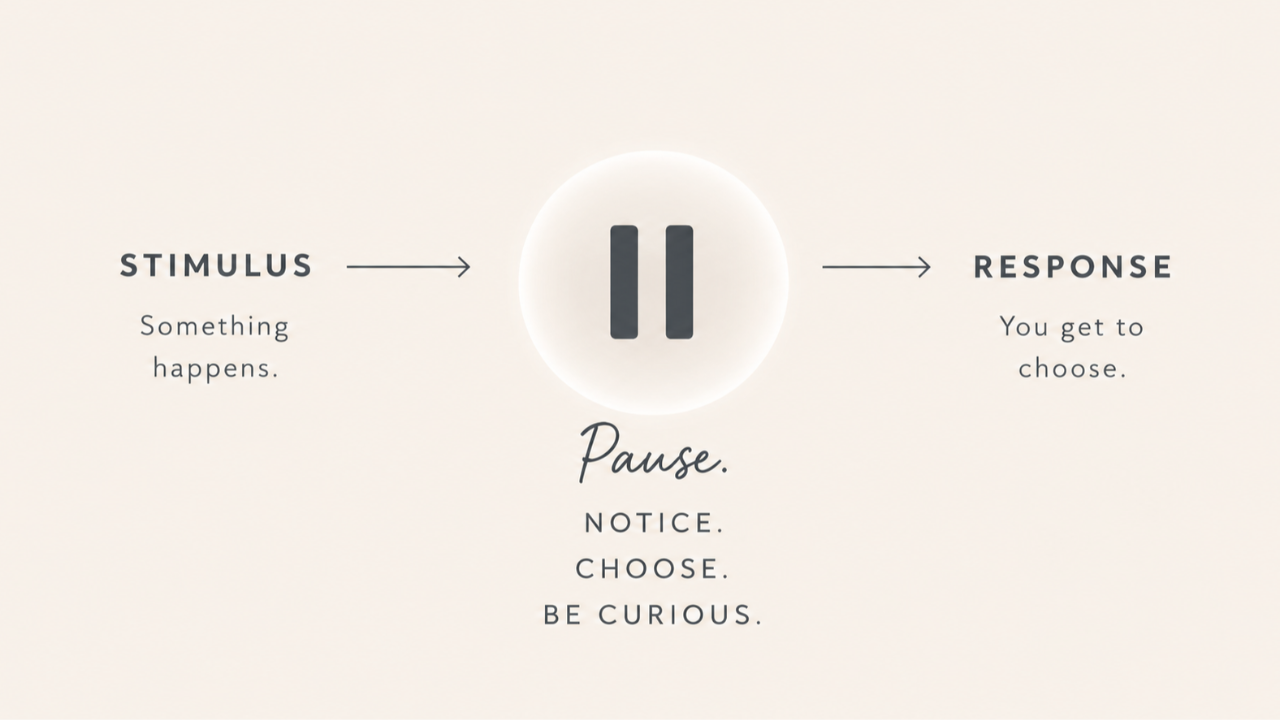
“Between stimulus and response there is a space. In that space is our power to choose our response. In our response lies our growth and our freedom.”
― Viktor E. Frankl
Have ever wondered why you keep reacting the same way, repeating the same patterns, or believing the same painful stories about yourself?
Most of us are not choosing as much as we think we are. We are reacting. We are living from old conditioning, old identities, old beliefs, and old stories we never stopped to question. We think we are responding to life, but often we are responding to the meaning our mind instantly gives to life.
And that meaning may not be true.
We are not our thoughts. We are the ones noticing our thoughts. This is a yogic philosophy that dates back thousands of years. But what does it really mean?
I understand that exploring ancient texts and philosophies is not everyone’s jam but stick with me for a bit.
We operate on an invisible automatic path. Stimulus. Thought. Emotion. Reaction. Most of us never notice the thought. It happens so quickly that we assume the thought is reality. This is the default human operating system. Without awareness, there is only conditioning.
We see the stimulus. We attach a story to it. We remember how we reacted before, or how we are “supposed” to act, and we respond accordingly. This is how habits are formed. This is how identity is formed.
The freedom Viktor Frankl speaks about lies in that small gap between stimulus and response. Freedom exists in a fraction of a second. Frankl’s awareness of this gap was forged during what we would consider one of the harshest human experiences imaginable: a Nazi concentration camp. He had almost everything taken from him. His family. His work. His freedom. His possessions.
Yet he realized something profound.
While his captors controlled his circumstances, they could not completely control the one thing that remained. His inner response.
What does it take to remind ourselves that we have a choice?
Pausing. Noticing. Questioning the story, the emotion, the “truth” we are telling ourselves. Becoming aware of where the automatic response is coming from and taking long enough to ask, “Is this still serving me?”
In other words, we need to get curious.
Two distinct traditions describe this same moment. Frankl and modern psychology would say, “There is a space between stimulus and response.” Patanjali, in the Yoga Sutras, and other ancient texts, would say we suffer because we identify with the movements of the mind. We become attached to the identity we believe we are, and then we respond the way we have been conditioned to respond.
But are we really that?
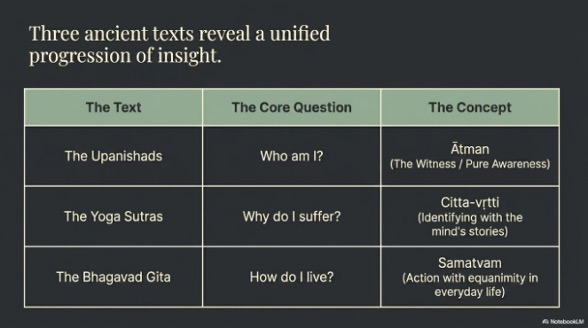
The Upanishads ask the simple question, “Who am I?” But they are also asking a question most of us never stop to consider. Who is noticing the thought?
When your mind says, “I’m a failure,” something inside you notices that sentence. That observer cannot be the thought itself. Ancient yogic philosophy calls this the witness. Modern mindfulness calls it awareness. Whatever name you give it, discovering that witness changes everything. We are the witness, not the thing being witnessed.
Imagine you are outside on a beautiful blue-sky day, and suddenly the clouds roll in. The sky becomes dark and stormy. The Upanishads separate the witness from the weather. In other words, we are the sky. If you have ever flown above the clouds during a storm, you know that no matter how many clouds roll in, the sky behind them remains unchanged. The sky cannot be wounded or diminished by the weather.
The weather is our thoughts, emotions, memories, and physical sensations. They rise, change, and pass. They are temporary. They do not change the sky.
You are the sky, not the weather.
The Yoga Sutras ask, “Why do I suffer?” In their teachings, they diagnose a fundamental human mistake. Our belief that we ARE what we are experiencing. There is a vast difference between saying, “I am experiencing fear.” and “I am fear.” There is a vast difference between saying, “I did something wrong.” and “I am wrong.”
We suffer not because we have thoughts, but because we become our thoughts. Our shame. Our labels. Our failures. Our beliefs.
The Bhagavad Gita explores yet another question: “How do I live?”
The Bhagavad Gita, or “Song of God,” is a 700-verse Hindu scripture about a warrior named Arjuna and his spiritual guide, Krishna. Facing a moral crisis on the battlefield, Arjuna receives timeless lessons on duty, the soul, and the path to spiritual peace. A key theme is that the mind is restless, powerful, and turbulent. It is only through practice and non-attachment that it becomes steady. Reliable. Consistent. Trusted.
Krishna never tells Arjuna to stop thinking. He invites him into the space before action. In other words, don’t let your first thought make your decision. He is reminding him of the precious pause explored by Frankl.
Think about the last difficult conversation you had. Maybe your partner criticized you. Maybe your boss questioned your work. Maybe your child said something that landed in a tender place. Before you even realized it, your mind may have already written the story. I’m not good enough. They’re attacking me. I have to defend myself. I always get this wrong. No one appreciates me.
The Bhagavad Gita reminds us that we do not have to let the first thought become the final decision.
So where does curiosity fit into the picture?
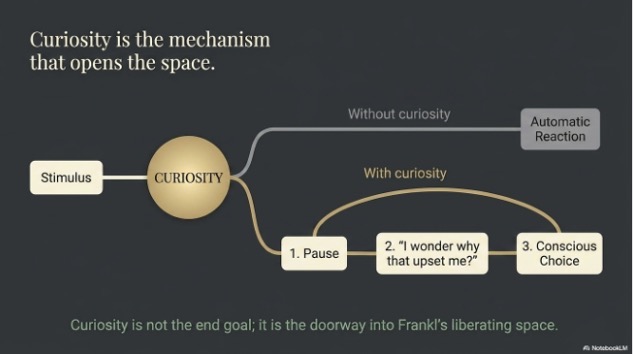
Curiosity is the mechanism that opens the space between stimulus and response. Curiosity is not the end goal. It is the doorway into Frankl’s liberating space. Curiosity encourages us to notice what is happening. And until we notice, we are stuck in our automatic response. Without noticing, there can be no opportunity for change.
Getting curious allows us to make a conscious choice, not an automatic one.
When we pause, we give ourselves the opportunity to notice what is happening and become curious about our next step. Noticing replaces rigid conditioning with conscious choice. Only after noticing can we choose. Without noticing, there is no choice. There is only our conditioned response, which we often mistake for identity. Instead of recognizing that we feel wrong, angry, hurt, or ashamed, we believe we are wrong, angry, hurt, or ashamed.
How do we learn to live from awareness? Practice. Presence. Patience. Equanimity. We learn how to pause, question, and make a conscious choice without becoming consumed by the mind. We are not our thoughts. We are the witness to our thoughts.
As Carl Jung said, “Until you make the unconscious conscious, it will direct your life and you will call it fate.” When we do not face our hidden psychological patterns, habits, thoughts, and conditioned responses, they control our life. And we misinterpret them as destiny. Awareness is not something we achieve once. It is something we practice.
Every time we pause before reacting, every time we question the first story our mind tells, every time we become curious instead of certain, we widen the space Viktor Frankl wrote about.
We remember what the Yoga Sutras have taught for thousands of years. We make the unconscious conscious, just as Jung urged. And in that quiet space between stimulus and response, we discover something extraordinary. We are no longer living from our conditioning.
We are living from choice.
So here is the practice.
For the next twenty-four hours, notice one automatic reaction. Just one.
When you feel yourself tighten, defend, apologize, judge, numb, over-explain, shut down, or reach for distraction, pause and ask, “What story did my mind just tell me?” Then ask… Is it true? Is it old? Is it still serving me? What else might be possible?
You do not have to fix it. You do not have to solve it. You do not have to become someone new by tomorrow.
Just notice.
Because curiosity begins with noticing. And noticing is where choice begins.
Choose curiosity.
Notice everything.
Much Love,
Lisa
If you enjoyed this blog and believe someone else might enjoy it as well, please feel free to forward. If this was forwarded to you and you would like to hear more, please sign up below to receive future emails.
Lisa Hamil is a founding member and host for The SOS Collective, an online international women’s recovery and support group. However, this blog and any classes or coaching offered by Lisa Hamil LLC are separate from and not affiliated in any way with The SOS Collective.
Stay connected with news and updates!
Join our mailing list to receive the latest news and updates from our team.
Don't worry, your information will not be shared.
We hate SPAM. We will never sell your information, for any reason.
