
“Words. English words, are full of echoes, of memories, of associations – naturally. They have been out and about, on people’s lips, in their houses, in the streets, in the fields, for so many centuries. And that is one of the chief difficulties in writing them today – that they are stored with meanings, with memories, that they have contracted so many famous marriages.”
-- Virgina Woolf
We like to believe that when we speak, we are being understood. That the words we choose, carefully and intentionally, carry a meaning that lands intact on the other side. That if we say it clearly enough, kindly enough, directly enough… the other person will hear what we meant.
But what if that’s not how it works at all?
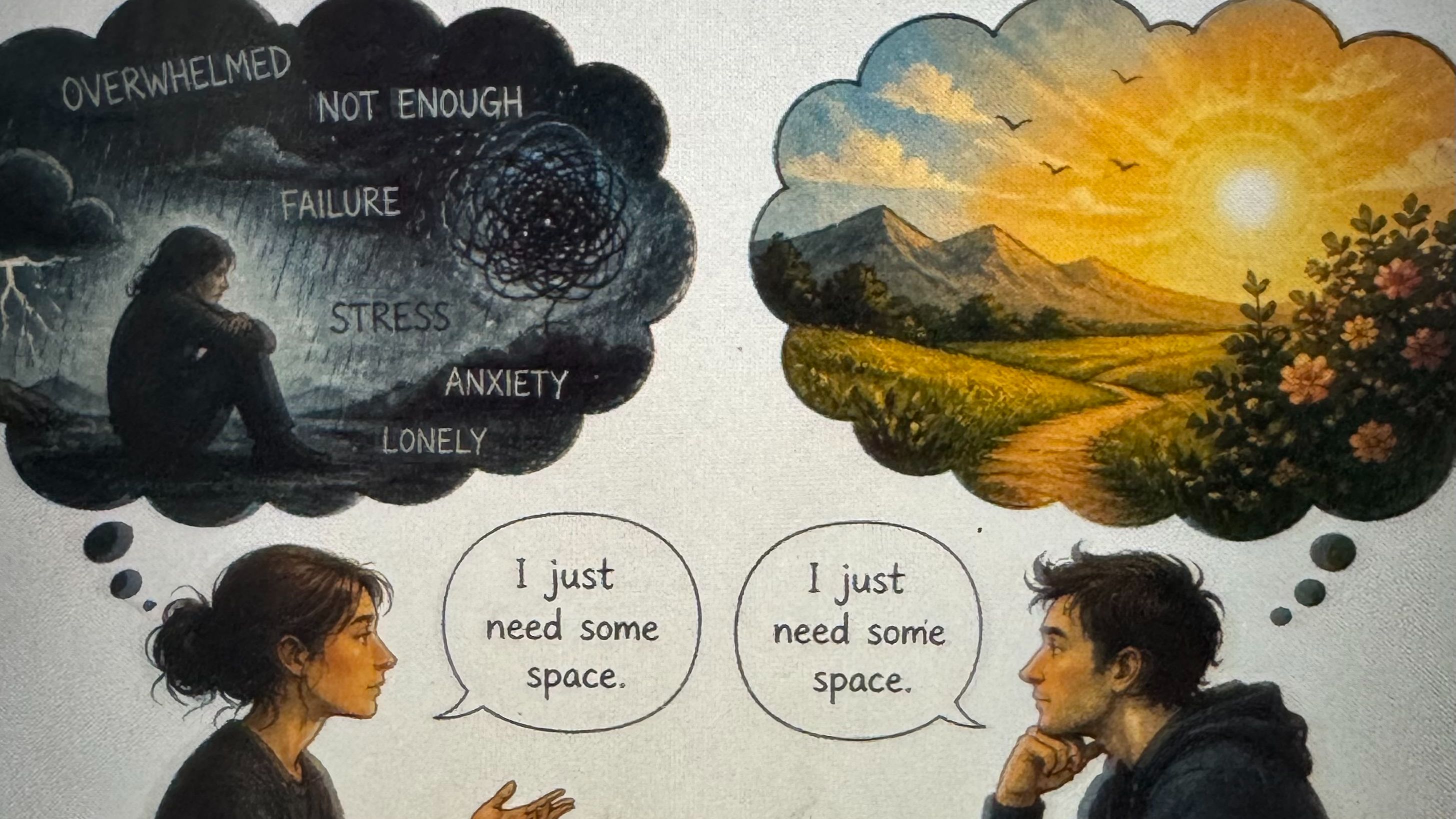
What if every conversation is less about shared meaning, and more about two people standing in completely different worlds, using the same words to describe them? What if we are not actually having the same conversation, but instead, meeting somewhere in the space between what we mean and what is heard?
We talk to people all day long. Quick exchanges. Casual check-ins. Deep, vulnerable conversations we’ve rehearsed a thousand times before finally speaking them out loud. But here’s the question I keep coming back to, “Are we ever actually having the same conversation?”
Words, by definition, have shared meanings. We rely on that. It’s how language works. But words also carry something far more personal. Memory, emotion, association, history. And those layers are never shared in quite the same way.
Take a simple word like rose. For one person, a rose might be tied to loss. The scent filling a funeral home, marking a goodbye they weren’t ready for. For another, it’s love. The first flower handed to them by someone who changed everything. For someone else, it’s just a plant. Or a color. Or a thorn. Even the image shifts. Is it a tight bud or a full bloom? Red or yellow? Soft or sharp?
That’s one word. Now imagine an entire conversation.
The Illusion of Shared Meaning
When we enter meaningful conversations, especially the vulnerable ones, we often come prepared. We’ve thought it through. Practiced. Edited. Rehearsed different versions in our mind until we feel ready. We have a script. But the other person? They didn’t get our copy.
And more importantly, they are not hearing our words the way we intend them. They are hearing them through their own lens, filtered by their experiences, their history with us, their emotional state, and their own internal narrative. Maybe a word we choose lands as a trigger. Maybe an analogy reminds them of something unresolved. Maybe they’re still holding onto something we said weeks (or years) ago. Or maybe…they simply disagree.
And suddenly, the conversation we’ve carefully crafted begins to unravel.
Not because we said it wrong. But because there is no single “right” way it can be received.
We are not just talking to someone. We are translating. Every conversation is an act of translation. We are translating our internal world into language. And the other person is translating that language back into their internal world. Somewhere in between, things get lost, reshaped, misunderstood. We think we’re being clear. We think we’re explaining ourselves well.
But clarity is not just about what we say. It’s about what someone else hears. And we don’t control that.
So What Do We Do With That?
If we can’t control how our words land, how do we approach the conversations that matter most?
Not with perfection nor with the perfect script. But with awareness. Here are a few shifts that have changed the way I approach conversations. Especially the hard ones.
1. Accept that they will have their own interpretation. No matter how carefully you choose your words, the other person will filter them through their own experience. Their response may surprise you. It may not align with your intention. That doesn’t mean you failed. It means you’re human, and so are they.
2. Ask for what you want, but release the outcome. Clarity in what you need matters. But so does recognizing that the other person may not be able, or willing, to meet that need. Both can be true at the same time.
3. Stop over-explaining. There’s a point where more words don’t create more understanding. They create more noise. Say what you came to say. Let it stand. Repeating it in ten different ways rarely changes the outcome.
4. Let go of the need for resolution. We often enter conversations expecting closure, agreement, or a clear “answer.” But most meaningful conversations don’t end that way. Sometimes, being heard, even imperfectly, is enough.
5. Protect your boundaries. Not every conversation is safe. Not every person is capable of meeting you with respect. If you walk away feeling like you honored yourself, even without achieving the outcome you wanted…that matters. And if someone consistently meets you with cruelty, distance is not failure. It’s wisdom.
6. Get curious about their perspective. We think we do this, but often we don’t. We’re too focused on being understood to truly understand what they saying to us. Particularly if we perceive it as criticism. What are they reacting to? What might they be seeing that you can’t (or don’t want to) see? Self-reflection is often uncomfortable. Seeing ourselves through the eyes of another is also very valuable.
7. Release the expectation that others will show up how you need them to. They are not you. They don’t share your internal world, your timing, your emotional capacity, or your readiness. Expecting them to respond exactly how you need them to is often where disappointment begins.
8. Lead with empathy and compassion. For them. For yourself. This is hard work. Communicate honestly while holding space for differences. Grace goes a long way here.
9. Be cautious of “right” and “wrong.” Most conversations don’t live in absolutes. They live in the space between perspectives. There is often more than one “right” outcome. The question becomes less about winning, and more about finding something that works.
Maybe the Goal Isn’t Agreement
The goal of conversation isn’t to be perfectly understood. Maybe it is just to be honest. To speak in a way that feels aligned. To listen with a willingness to be changed. To leave knowing you showed up as yourself. Not as a script, not as a performance.
Because the truth is, we may never be having the exact same conversation. But we can still meet each other in it. Even imperfectly. Even with different meanings attached to the same words.
And maybe that’s exactly what Virginia Woolf was pointing to.
That words are not clean or neutral or universally shared. They are layered. Lived in. Worn down and built up over centuries of human experience. They carry the echoes of every person who has ever spoken them. So when we speak, we are not just choosing words. We are offering up our history, our associations, our meaning…and placing it gently into the hands of someone who will inevitably receive it differently.
Not wrongly.
Just differently.
And maybe communication isn’t about closing that gap. Maybe it’s about respecting it. Being aware of it. Holding space for it.
Because connection doesn’t come from perfectly matched meanings. It comes from the willingness to stand in the space between the perceived meanings and speak anyway. Listen anyway. To at least try to meet at a place of mutual understanding. .
Even knowing…we are never quite saying the same thing.
Much love (and happy conversations),
Lisa
If you enjoyed this blog and believe someone else might enjoy it as well, please feel free to forward. If this was forwarded to you and you would like to hear more, please sign up below to receive future emails.
Lisa Hamil is a founding member and host for The SOS Collective, an online international women’s recovery and support group. However, this blog and any classes or coaching offered by Lisa Hamil LLC are separate from and not affiliated in any way with The SOS Collective.
Stay connected with news and updates!
Join our mailing list to receive the latest news and updates from our team.
Don't worry, your information will not be shared.
We hate SPAM. We will never sell your information, for any reason.
